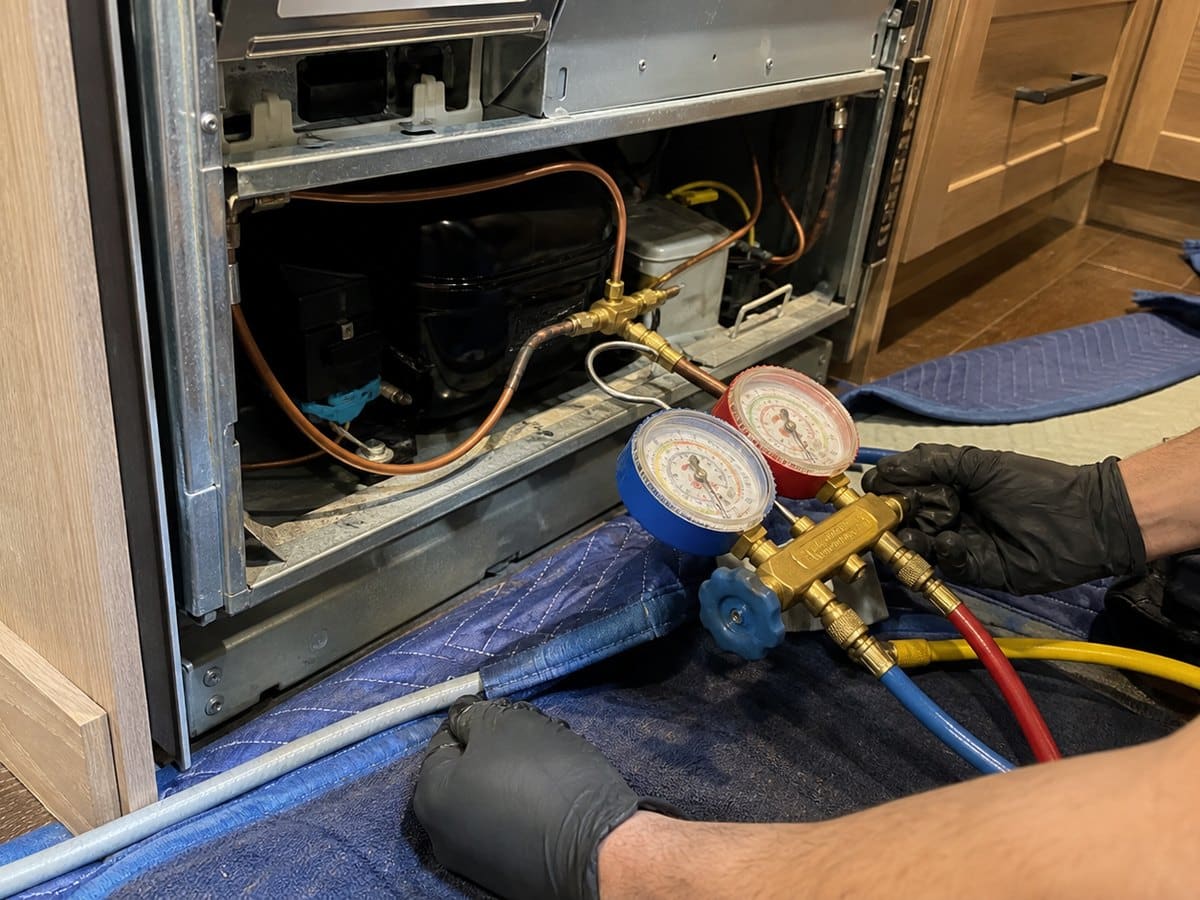
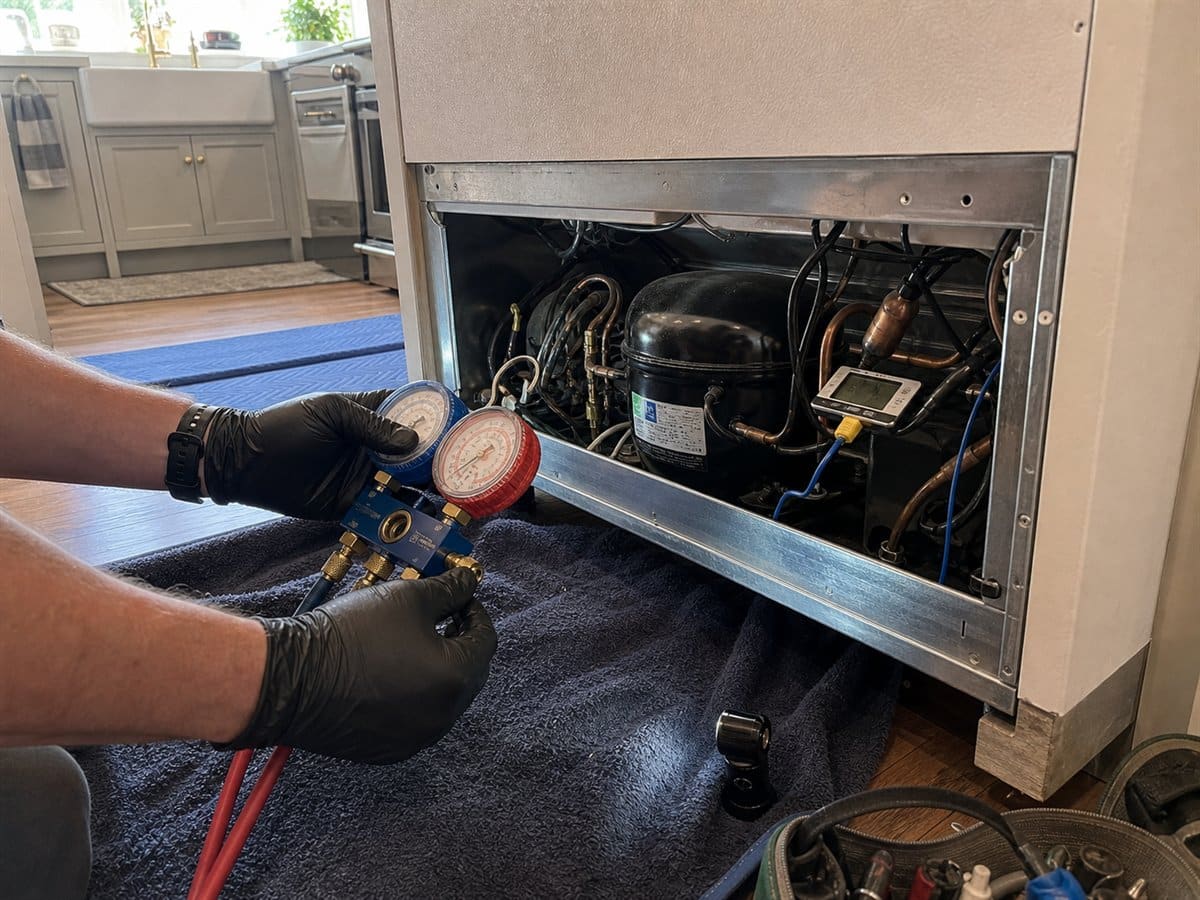
Both compartments warmed and the compressor ran hot, but they would not quote sealed-system work until testing. Pressure and temperature behavior proved a restriction, and they explained the $2,240 repair before starting. The job took 5 hours plus parts and held 37°F afterward.
Technical · Sealed system & compressor
Sealed system & compressor diagnosis
In plain language, the cabinet removal and reseat is half the job here: a built-in column is wedged between custom panels with water and power routed behind it, so reaching the sealed system means disconnecting it cleanly, sliding it out without marking the millwork, and re-leveling it afterward so the doors seal again. What confirms whether a pull is even needed is the diagnosis up front — a high-side problem caused by a dirty condenser is solved at the grille, while a true sealed-system leak requires access. What we cannot know before we read the system is which of those you have.

Safety first
What an owner can check — and what to leave alone
Safely owner-checkable: whether the condenser coil is packed with dust or pet hair (look at the grille and the coil behind it), whether the unit has airflow clearance, and whether the symptom is one compartment or both. That is the boundary. Refrigerant, the compressor, the sealed tubing and the control electronics are not DIY territory — refrigerant is regulated, the system is under pressure, and the wrong move contaminates a system that was otherwise repairable. If you suspect a sealed-system fault, stop running the unit hard and book a certified diagnosis rather than trying a "recharge" product. The cans of "fridge sealer" and universal refrigerant sold for DIY use are a particular trap on a Sub-Zero: they can contaminate a system that was otherwise a clean, repairable leak, turning a bounded job into a full component replacement.
Diagnostic table
Symptom → component → test → repair
| Symptom | Possible component | Confirmation test | False positive to avoid | Repair path |
|---|---|---|---|---|
| Both compartments slowly warm | Refrigerant charge / leak | Pressure & temperature across a cycle | Calling it a leak when the coil is dirty | Locate, repair, evacuate, recharge, verify |
| Compressor hot, runs nonstop | Condenser airflow / compressor | Head temp; airflow at the coil | Replacing compressor before cleaning coil | Clean & retest; compressor only if confirmed |
| Compressor silent, no cooling | Start components / compressor | Electrical check at the compressor | Assuming dead compressor vs start relay | Replace start component or compressor |
| Freezer ok, fridge warm | Single-evaporator airflow | Evaporator temp & fan | Treating airflow as a refrigerant fault | Fan / defrost repair, not sealed-system |
| Frost on suction line | Charge / metering device | Superheat behavior | Adding refrigerant to a metering fault | Correct the metering / charge issue |
| Short-cycling | Control / overload | Cycle timing & overload check | Blaming the board before the overload | Replace the confirmed component |
| Oil residue at a joint | Sealed-system leak | Leak confirmation by behavior | Sealing cosmetically over a real leak | Proper leak repair, evacuate & verify |

Model-family notes
How the line changes the approach
Classic 500 series: older dual-compressor platforms; confirm which system is affected before any sealed work — verify by model/serial.
600 series built-ins: common in 1990s–2000s Montclair remodels; condenser load is the frequent masquerader — verify by model/serial.
BI columns: all-refrigerator or all-freezer behavior changes the expected temperatures — verify by model/serial.
Designer integrated: tight cabinetry raises the reseat factor on any sealed access — verify by model/serial.
We do not publish exact code or pressure values by model here, because they are revision-specific and a wrong number is worse than none. They are confirmed on site against your serial.
Short case row
How these resolve
Looked like a leak
Both sides warming, compressor hot. Coil was packed solid; head pressure normalized after cleaning.
No sealed-system work needed. Verified over a cycle.
Oil at a joint
Slow warming with residue at a sealed joint; behavior confirmed the leak.
Repaired, evacuated, recharged and verified to spec.
Seal-driven load
A chronic door-gasket leak had stressed the system into long runs.
Seal corrected first; system held without sealed work.

Sealed-system FAQ
How do you confirm a refrigerant leak without guessing?
By behavior, not assumption. We read pressures and temperatures across a cycle and watch how the system pulls down. Refrigerant work is EPA-regulated, so a leak is confirmed with proper instruments and recovered correctly — we never "top it off" and hope.
Is a failed compressor the end of the unit?
Not on a Sub-Zero with a sound cabinet. Compressors and sealed-system components are serviceable, and replacement is a real repair rather than a write-off. We compare the cost against the unit’s age and condition so you can decide with numbers.
Why does sealed-system work cost more?
It is regulated, time-intensive and serial-specific: recovery, repair, evacuation, charge and verification all take time and certification, and the parts are matched to your exact model. We explain the scope before starting so there are no surprises.
Can a dirty condenser look like a sealed-system failure?
Yes, and that is exactly why we check airflow first. A coil packed with dust and pet hair drives high head pressure that mimics a refrigerant fault. Confirming the coil rules out an expensive misdiagnosis.
When should a Montclair compressor quote include cabinet access?
When the compressor or sealed tubing cannot be reached from the grille area, the quote should include protected pull-out and reseat planning. In panel-ready 94611 kitchens that support can add $215-$975 depending on floor protection, water line and two-person staging.
What proof separates a dirty condenser from a sealed-system fault?
The useful proof is temperature pull-down, condenser airflow, compressor behavior and pressure/temperature evidence. A dirty coil can make both sections warm, but sealed-system work in the $1,420-$3,475 range should not be named until airflow false positives are ruled out.
Reviews
Sealed-system quote proof from Oakland Hills jobs
A previous quote said compressor without evidence. This technician cleaned the condenser first, then used gauges and electrical readings to prove the real sealed-system fault. The final $3,120 repair was expensive, but the proof made sense and the freezer held 0°F.
D.H., Oakland Hills
Our BI-48 needed rear access in a tight cabinet before the leak could be repaired. They added protected pull-out support, recovered and recharged correctly, then reseated the unit. Total sealed-system work was $2,875 and the doors lined up when they left.
Homeowner, Oakmore
Montclair service
Planning ranges and service area
Local entity: Montclair means the Montclair neighborhood of Oakland, California in Alameda County, including 94611 and 94618, not Montclair, New Jersey.
- Typical Montclair sealed-system planning range: $1,420-$3,475, with 2-6 hours onsite plus parts lead time after pressure and electrical proof.
- A compressor quote should not be issued from a warm-cabinet complaint alone; airflow, condenser fan behavior and temperature pull-down are checked first.
- Panel-ready Oakland Hills cabinetry can add $215-$975 of protected pull-out or reseat work when rear compressor access is actually needed.
| Service / symptom | Planning price range | Typical time | What is included |
|---|---|---|---|
| Diagnostic / service call | $135-$205 | 45-90 min | Includes onsite model verification, temperature readings, condenser airflow and visual cabinet checks. |
| Evaporator or condenser fan / damper | $365-$825 | 1-3 hours | Covers airflow testing, serial-matched fan or damper work and post-repair temperature recovery. |
| Door gasket / frost-line repair | $365-$885 | 1-3 hours | Depends on exact gasket profile, hinge alignment and cabinet fit. |
| Ice maker / water line repair | $295-$875 | 1-3 hours | Separates inlet valve, fill tube, filter, module and temperature-side causes. |
| Control board / sensor diagnosis | $385-$1,280 | 1-4 hours | Quoted only after electrical evidence and serial revision check. |
| Cabinet-safe pull-out / reseat support | $215-$975 | 1-4 hours | Applies when panel-ready access, floor protection, water shutoff or two-person staging is needed. |
| Compressor / sealed system | $1,420-$3,475 | 2-6 hours plus parts | Requires pressure/electrical evidence before quoting refrigerant or compressor work. |
Final price is set by the model and serial, cabinet access, verified readings, part revision and whether the first visit proves a part-level repair or sealed-system work.
Last updated: 2026-06-05. Planning ranges are estimates; the final quote depends on model, access, diagnosis and part availability.