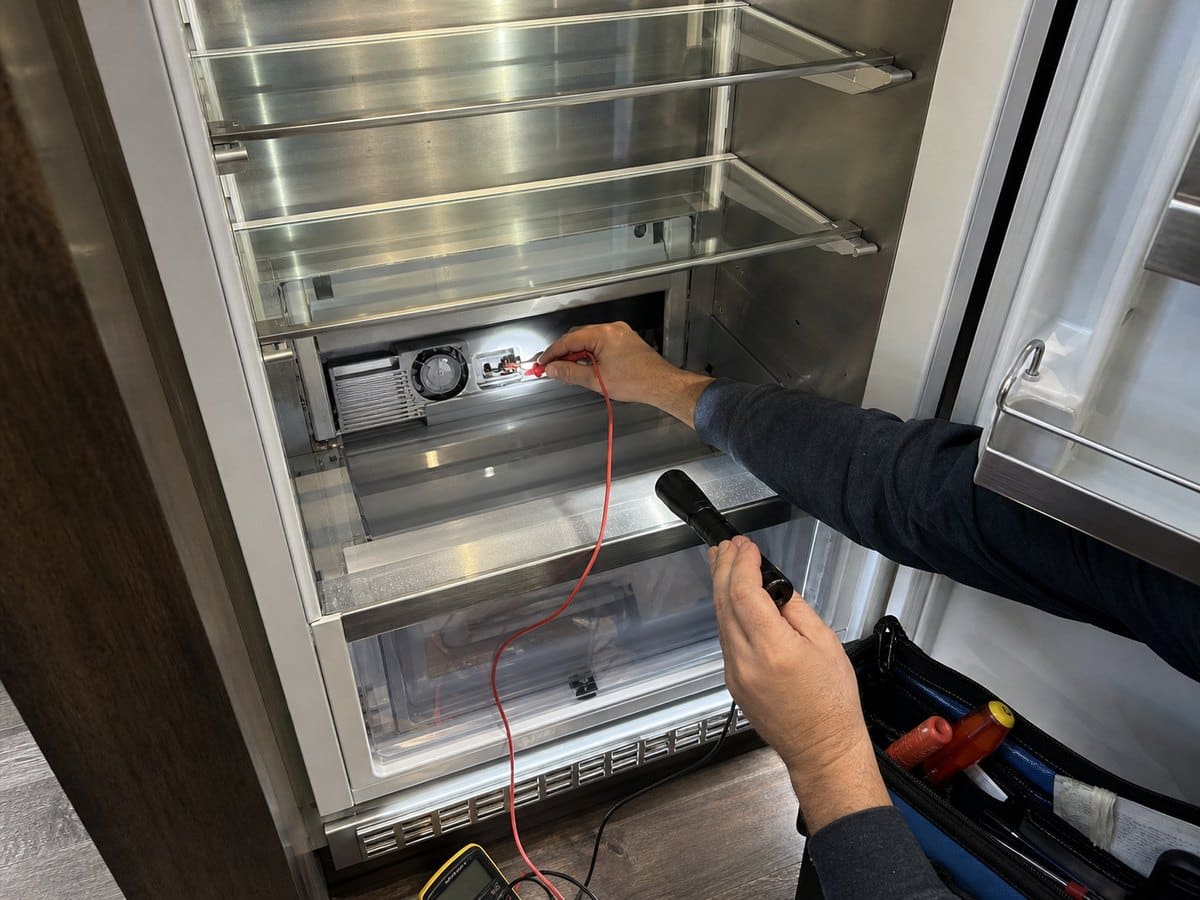
Both compartments were warming after a power event, so we feared the compressor. They preserved the alarm history, tested condenser airflow and found a control-side startup issue. The repair was $865, took 3.5 hours and brought freezer temperature back to 0°F.
Symptom hub · Montclair Oakland Hills
Sub-Zero not cooling in Montclair: read the pattern before naming the part
Last updated: 2026-06-05. Planning ranges are estimates; the final quote depends on model, access, diagnosis and part availability.

Decision tree
What the symptom usually means
| Pattern | Likely first checks | Homeowner-safe check | Do not do |
|---|---|---|---|
| Fresh-food warm / freezer OK | Evaporator fan, damper, frost load, blocked return, gasket leak | Record both temperatures and listen for fan after door switch closes. | Do not keep opening doors or resetting controls. |
| Both compartments warm | Condenser airflow, compressor start, control, sealed-system evidence | Move perishables if unsafe and leave displays/alarms intact. | Do not add refrigerant or use leak sealer. |
| Constant running | Dust-loaded condenser, weak fan, warm room, door leak | Look for blocked grille or heavy dust without opening sealed panels. | Do not pressure-wash condenser fins. |
| Frost on back wall or edge | Defrost problem, air leak, gasket or door alignment | Note frost location before defrosting if food safety allows. | Do not defrost repeatedly as a permanent fix. |
| Fan noise or no fan sound | Evaporator or condenser fan fault, ice obstruction, control issue | Note when sound changes: door open, compressor on, after reset. | Do not poke fan blades or remove rear panels. |
| Alarm or error | Serial-specific sensor/control condition | Record the code and leave the alarm history intact. | Do not clear the alarm repeatedly before diagnosis. |

Montclair, Oakland Hills
Why a Montclair not-cooling call needs access notes
In Montclair, scheduling should stay simple: call or book online, then preserve the current fault state for diagnosis. During the visit, the technician verifies model and serial, reads both temperatures, checks grille airflow and reviews cabinet access before any pull-out work. Seasonal dust, pollen and smoke in the Oakland Hills can load a Sub-Zero condenser and cause long run times or slow temperature recovery.
| Montclair condition | Why it matters | Prep that prevents delay | Source page |
|---|---|---|---|
| Hillside road or narrow drive | Scheduling and equipment staging can affect arrival window, not diagnosis. | Mention parking or access constraints when calling or booking online. | Hillside service prep |
| Older panel-ready built-in | Custom panels may hide grille, water line and leveling hardware. | Technician verifies cabinet access before any pull-out work. | Cabinet-safe guide |
| Dust, pollen or smoke load | Condenser airflow loss can imitate larger refrigeration faults. | Leave the visible grille area accessible for inspection. | Airflow maintenance |
| Wine or integrated column | Temperature drift can be sensor, damper, control or airflow, not just refrigerant. | Keep set points and actual readings available for diagnosis. | Wine storage guide |
Safe checks
What to check before requesting service
Check that both doors close fully, the set points have not been changed, the grille is not blocked and the unit has not just recovered from a power event. Record fresh-food and freezer temperatures with an independent thermometer if possible, and leave any display, frost or alarm evidence intact for the technician. Those facts help separate an airflow problem from a control or sealed-system issue.
What not to do matters just as much: do not force a panel-ready unit out of its cabinet, do not repeatedly reset the control board, do not treat a one-time defrost as a repair and do not attempt refrigerant work. Montclair kitchens often have trim, custom panels and tight floors around the built-in; a rushed pull-out can create a second repair.
| Symptom | First evidence to check | Do not do this | Likely next page |
|---|---|---|---|
| Fresh-food warm, freezer OK | Fresh-food reading, freezer reading, evaporator fan sound and frost pattern. | Do not keep resetting controls. | Not-cooling hub |
| Long run time, slow recovery | Condenser coil load, grille clearance and room temperature around cabinetry. | Do not pressure-wash or bend condenser fins. | Dust and airflow |
| Frost line at door edge | Gasket contact, hinge drop, condensation path and cabinet alignment. | Do not tape, glue or heat-warp the gasket. | Door gasket guide |
| Both sections warm | Condenser, compressor start behavior, amp draw and pressure/temperature evidence. | Do not use recharge cans or leak sealer. | Sealed-system guide |
Not-cooling FAQ
Short answers for the common patterns
What should I check before calling for a Sub-Zero refrigerator not cooling in Montclair?
Safely check door closure, set points, recent power events, blocked grilles and two temperature readings: fresh-food and freezer. Do not remove sealed-system panels, force a cabinet pull-out or keep resetting alarms; those actions can erase useful fault evidence or damage custom cabinetry.
Why is my Sub-Zero fresh-food section warm while the freezer is cold?
That pattern usually points first to airflow, an evaporator fan, a stuck damper, defrost frost or a gasket leak. It is not enough evidence to quote a compressor. The first useful readings are fresh-food temperature, freezer temperature and whether the evaporator fan and airflow path are behaving.
What if both compartments are warm?
Both compartments warm is more serious because it can involve condenser airflow, compressor start behavior, control failure or sealed-system evidence. Move perishables if temperatures are unsafe, leave the fault state intact and do not keep power-cycling the unit before diagnosis.
Can Oakland Hills dust make a Sub-Zero stop cooling?
Yes. Seasonal dust, pollen and smoke can load the condenser and cause long run times or slow recovery. Cleaning may solve the problem, but only if temperature recovery and airflow are verified afterward; a dirty condenser can also reveal a fan or control weakness.
Is same-day Sub-Zero repair available in Montclair?
Same-day may be realistic when routing and parts line up, but the site should not promise it for every hill address. Call or book online for the most accurate service window; the technician verifies model, readings and access during the visit.
Can a Sub-Zero built-in be serviced without damaging custom cabinets in Montclair?
Yes, but only if access is planned. Many Montclair and Piedmont Pines kitchens have panel-ready built-ins in tight cabinetry, so the technician checks floor protection, trim clearance and model information before pull-out work is assumed.
Reviews
Not-cooling repair evidence from hill kitchens
Our panel-ready unit sat slightly out of level after prior work, pinching airflow and making the fridge side warm. They protected the floor, reseated the unit and corrected the damper response. The $575 visit took under 3 hours and ended with 37°F readings.
Homeowner, Glen Highlands
Our BI-36 fresh-food side hit 48°F while the freezer stayed at 0°F. The technician found a stalled evaporator fan, installed the matched motor and verified 37°F after a full cycle. The visit took 2 hours and cost $642, exactly inside the airflow range.
Homeowner, Montclair Village
Montclair service
Planning ranges and service area
Local entity: Montclair means the Montclair neighborhood of Oakland, California in Alameda County, including 94611 and 94618, not Montclair, New Jersey.
- A Sub-Zero fresh-food compartment near 37°F is normal; fresh-food above 44°F while the freezer stays near 0°F usually starts as airflow, fan, damper, frost or gasket diagnosis.
- Typical Montclair fan, damper or airflow repair range for a not-cooling complaint: $365-$1,280, depending on serial-specific parts and cabinet access.
- Seasonal Oakland Hills dust, pollen and smoke can make a restricted condenser mimic a sealed-system fault until airflow and recovery are measured.
| Service / symptom | Planning price range | Typical time | What is included |
|---|---|---|---|
| Diagnostic / service call | $135-$205 | 45-90 min | Includes onsite model verification, temperature readings, condenser airflow and visual cabinet checks. |
| Evaporator or condenser fan / damper | $365-$825 | 1-3 hours | Covers airflow testing, serial-matched fan or damper work and post-repair temperature recovery. |
| Door gasket / frost-line repair | $365-$885 | 1-3 hours | Depends on exact gasket profile, hinge alignment and cabinet fit. |
| Ice maker / water line repair | $295-$875 | 1-3 hours | Separates inlet valve, fill tube, filter, module and temperature-side causes. |
| Control board / sensor diagnosis | $385-$1,280 | 1-4 hours | Quoted only after electrical evidence and serial revision check. |
| Cabinet-safe pull-out / reseat support | $215-$975 | 1-4 hours | Applies when panel-ready access, floor protection, water shutoff or two-person staging is needed. |
| Compressor / sealed system | $1,420-$3,475 | 2-6 hours plus parts | Requires pressure/electrical evidence before quoting refrigerant or compressor work. |
Final price is set by the model and serial, cabinet access, verified readings, part revision and whether the first visit proves a part-level repair or sealed-system work.
Last updated: 2026-06-05. Planning ranges are estimates; the final quote depends on model, access, diagnosis and part availability.